
Safe place
How a wild 'Goose' chase highlighted a Beverly reptile sanctuary’s efforts
Today we’re turning The Beverly Beat over to a story by Callie Trachtenberg, a student at Endicott College studying journalism. This story was published in partnership with the Massachusetts News Service, which was founded by Endicott College Distinguished Professor of Journalism Lara Salahi and collaborates with local news organizations.
Goose — an Asiatic water monitor and, apparently, a skilled escape artist — caused a stir across local headlines last year after slipping out of a second-story window at his former home in Webster.
For two weeks, the four- to five-foot reptile was on the loose, eventually settling into a routine: basking comfortably on a road in Douglas. In nearby towns, though, the story took on a life of its own.
“There was this loose, giant, huge water monitor that’s 12, 100, 600 feet long,” joked Mack Ralbovsky, vice president of RRS Oasis.
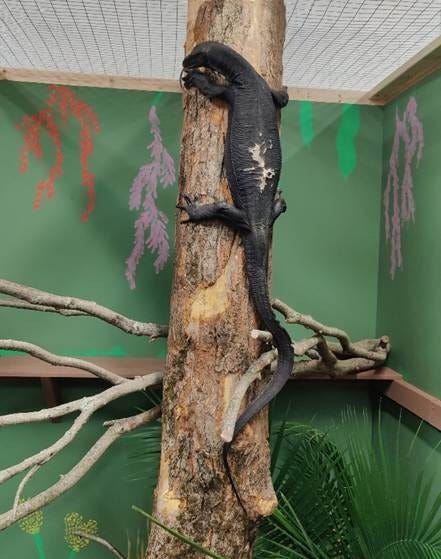
After his brief run as a local legend, Goose was safely captured by the Massachusetts Environmental Police and transferred to a new, more appropriate home. Today, he lives at RRS Oasis, a sanctuary in Beverly. He’ll be staying there permanently because, as Ralbovsky put it, he’s “an illegal animal in the state of Massachusetts.”
Goose’s adventure is unusual, but the ending is exactly what RRS Oasis was built for.
As the organization prepares to celebrate its 10th anniversary on June 6, his story offers a glimpse into the work they’ve been doing quietly — and sometimes dramatically — for years. The group is inviting the community to Burlington High School from 11:30 a.m. to 3:30 p.m. on June 6 for a family-friendly event focused on wildlife education and conservation.
“We’ll have entertainment, food, and we’re hoping to make this the biggest event we’ve ever (hosted),” Ralbovsky said.
Goose is just one of more than 1,000 animals the nonprofit takes in each year. RRS stands for Reptile Refuge and Sanctuary, while OASIS stands for Offering Animal Support Inspiring Survival — a name that reflects both the scale and the purpose of the work.
“It was established in conjunction with Rainforest Reptile Shows in 2016, because of the sheer amount of animals that we had coming in,” Ralbovsky said.
Many of those animals arrive because they were never meant to be pets in the first place.
“When I first entered this field, the standard policy was to euthanize these (reptiles), especially those considered dangerous or unpredictable,” said Joan Gallagher, founder of RRS Oasis.
That approach has shifted, but the demand hasn’t slowed.
“Over the years, unfortunately, we have consistently seen people choosing to make the illegal decision to have alligators and venomous snakes as pets,” said Kristen Bryan, facilities manager for Rainforest Reptile Shows and RRS Oasis.
The sanctuary has taken in spitting cobras, venomous snakes, and crocodilians —animals that can’t be rehomed and instead live out their lives at the facility.
The roots of this work go back even further, before the sanctuary itself existed.
In 1996, an overexcited student brought a pet cobra to Stoneham Elementary School, prompting a tense situation that ended with the snake being pulled from beneath a child’s backpack.
Today, RRS Oasis uses moments like that as teachable ones. The organization regularly visits schools, aiming to build understanding rather than fear.
They focus on helping people understand “why the natural world is so important to every human being on the planet,” Ralbovsky said.
That educational role extends beyond classrooms.
The organization also trains law enforcement agencies, both nationally and internationally, on how to safely handle dangerous reptiles. Their work has included capturing 12-foot alligators, assisting in exotic animal cases involving tigers, and responding to severe neglect situations.
Some of those calls are hard to forget.
Ralbovsky recalls a 2016 case in Weston, Conn., where he entered a home containing more than 500 birds and thousands of snakes.
“There were dead snakes on top of dead snakes, on top of dead snakes — and on top of that, there were snakes that were still alive,” he said. The birds were in similarly dire conditions, with waste piled so high it restricted their movement.
Even so, the work carries moments that keep staff going.
“There is something so rewarding and fulfilling about being able to save a life,” Bryan said.
And not every story is so grim.
“We are lucky that most animals that come to us are not under serious distress,” Bryan added. Many reptiles are surrendered by owners who care about them but can no longer meet their needs.
Reptiles, staff emphasize, can be great companions (they’re hypoallergenic and relatively low-maintenance) but they still require specialized care and a real commitment.
“Reptiles can make very fun and personality-filled pets with the right care and understanding,” Bryan said.
They also challenge common assumptions.
“Snakes do build bonds with people,” Ralbovsky said, along with popular species like crested geckos, ball pythons, and bearded dragons.
Still, illegal ownership remains a persistent issue, which is often driven by the appeal of having something rare or dangerous.
That’s where RRS Oasis continues to step in. They educate the public, rescue exotic animals, and provide lifelong care when needed.
Interested ng story. Thanks for partnering with journalism students!
Yay Endicott journalism!